Vivre avec le syndrome de céphalopolysyndactylie de Greig

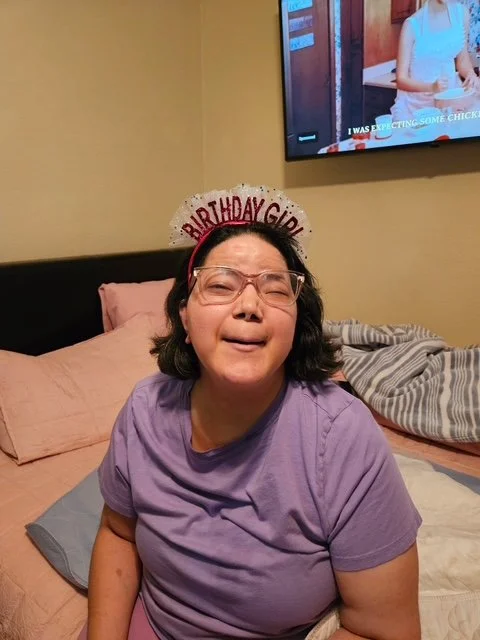
Jordynn, Amy’s daughter, living with GCPS
Votre fille ne marchera et ne parlera jamais
"C'était mon enfant miracle. J'ai choisi de garder le bébé, tout en sachant que je devrais tout résoudre à chaque étape du processus."
Defying the odds, Amy never thought she’d be able to have children. Her pregnancy was high-risk due to her own medical issues. However, she made it through her first trimester of pregnancy and was ready for an ultrasound at 18 weeks. Amy didn’t expect the doctors at her local hospital to tell her that her daughter would never walk or talk. From the ultrasound, the doctors explained that her daughter would have extra fingers and toes, and enlarged ventricles in her brain. Amy said, “This was my miracle child. I chose to keep the baby, knowing that I’d have to figure everything out every step of the way.”
Fifteen days after Jordynn’s birth, Amy took her daughter to see Dr. Catherine Nowak, a geneticist and the clinical director at The Feingold Center for Children, located at Boston Children’s Hospital and funded by The Genesis Foundation for Children. Amy, who had also been born with extra fingers and toes (known as polydactyly) and other medical issues, saw Dr. Nowak as a teenager because her pediatrician suspected that her problems might be due to a rare genetic disease. At that time, Amy’s genetic test results were normal because “we couldn’t test for the thousands of genes as we can today,” explained Dr. Nowak. With the improved medical technology, the doctor suggested testing both Amy, now age 22, and her 15-day-old daughter.
J'ai passé 22 ans à ne pas savoir ce qui n'allait pas chez moi.
“After 22 years of not knowing what was wrong with me, I was relieved to discover why I was different from everyone else. I learned that my daughter and I are a rare mother-daughter duo with Greig Cephalopolysyndactyly Syndrome.”
Greig Syndrome is caused by a mutation in the GLI3 gene, which is involved in the normal shaping of many tissues and organs during the early stages of fetal development. “The GLI3 protein can either turn on (activate) or turn off (repress) other genes,” causing secondary medical conditions.
Greig Cephalopolysyndactyly syndrome affects the development of the limbs, head, and face. It can also cause seizures, delayed development, and intellectual disability. Now that Amy knew what she and Jordynn were dealing with, she felt that, with Dr. Nowak’s guidance, she would be able to get Jordynn the necessary medical care and support so Jordynn wouldn’t just survive. She would thrive.
36 interventions chirurgicales en 11 ans
À 11 ans, Jordynn a subi 36 interventions chirurgicales différentes. La première opération a été pratiquée sur les mains de Jordynn lorsqu'elle avait quatre mois. À l'âge de six ans, et en l'espace de deux mois, Jordynn a subi son groupe d'opérations le plus important, qui comprenait une greffe osseuse dans un doigt, l'allongement bilatéral de ses tendons d'Achille et des opérations sur les tendons de ses orteils. Jordynn a ensuite passé huit mois dans un fauteuil roulant avant de pouvoir réapprendre à marcher. Elle a ensuite dû porter des orthèses cheville-pied (AFO) pendant les 18 mois suivants, puis des attelles bilatérales pour les genoux. Lorsque Jordynn en a eu fini avec les orthèses AFO, elle les a mises sous le sapin de Noël pour que le Père Noël puisse les offrir à un autre enfant dans le besoin.
Jordynn a passé d'innombrables heures en physiothérapie, ergothérapie et natation, sans compter le travail d'Amy avec elle à la maison. Amy et Jordynn savent que Jordynn devra subir d'autres interventions chirurgicales tout au long de sa vie.
Pas seulement une maladie rare, mais aussi un esprit rare
Lorsqu'Amy parle des complications de la maladie rare qu'est le syndrome de céphalopolysyndactylie de Greig, ce qui ressort comme particulièrement rare, c'est la combativité et la joie de vivre d'Amy et de Jordynn qui font briller leur lumière et aiment tous ceux qui les entourent.
Jordynn fréquente le collège public près de chez elle et a obtenu de très bonnes notes. Elle aime danser, être dans la nature, faire du vélo, jouer de la caisse claire et de la basse dans l'orchestre de son collège, dessiner et peindre, et jouer avec Sarge, son chiot berger allemand. Amy se souvient du jour où le médecin lui a dit que son enfant ne marcherait et ne parlerait jamais. Amy dit en riant : "S'ils pouvaient voir Jordynn maintenant, elle n'arrête pas de parler et est devenue si insolente".
Amy is grateful for Dr. Nowak, The Genesis Foundation for Children, and The Feingold Center for Children because their constant support and compassion have made all of this possible. Amy’s wish for Jordynn is that her “warrior spirit will guide her through life’s obstacles and that Jordynn’s big beautiful smile will continue to light up the world for everyone around her.”